Wednesday, August 01, 2007

Farmer's journalist wins Magsaysay award


Palagummi Sainath has won the 2007 Raman Magsaysay award, widely regarded as Asia's equivalent of the Nobel Prize, in recognition of his passionate reporting about the condition of India's rural poors.While announcing the award, the Board of Trustee of the Raman Magsaysay Award Foundation (RMAF) said that Sainath, who has been writing on social issues like farmer suicide in Andhra Pradesh and Maharashtra is among the seven individuals being awarded for their contribution in various fields.
"In electing Palagummi Sainath to receive the 2007 Ramon Magsaysay Award for Journalism, Literature, and Creative Communication Arts, the board of trustees recognizes his passionate commitment as a journalist to restore the rural poor to India's consciousness, moving the nation to action," the citation said.. adding the award will be presented in a ceremony here on August 31.
(source:Hindu.com)

Thursday, July 05, 2007

Farmers' widows


Farmers in India have been committing suicides due to  mounting debts and natural calamities . Now their families are helpless and hapless. The farmer’s widows are in extreme distress and suffering with serious problems. They have been harassed by money lenders who charge exorbitant interest rates. They often demand the partial repayment. Some of the places the moneylenders are forcing the widows for sexual exploitation. Their children are in high rate of malnutrition, high incidence of farm labor lack of proper education.
I trust these sorts of troubles may lead to suicides of farmer’s widows and orphanage to their children. I would like to suggest remedies that the Government should provide subsidized food, health and social security for the ill-fated farmer’s widows and their children. We should reinforce their lives to self-reliance.

Wednesday, June 27, 2007

Wonderful World Bank

The World Bank said on Wednesday(06.27.07)it had approved a $600 million loan for India to help it revamp thousands of ailing rural cooperative banks and fight village poverty through cheap loans.

"Better access to finance for India's rural poor is absolutely critical for higher rural growth, for reducing inequality and ultimately, alleviating poverty," Isabel Guerrero, the bank's country director for India, said in a statement.About 87 percent of marginal Indian farmers and 70 percent of small farmers have no access to credit from a formal financial institution, the World Bank said, adding they often have to rely on "extortionate" money lenders.
Thousands of farmers have committed suicide in recent years across India's sprawling western and southern plateau because they could not repay loans taken for their crops.The absence of cheaper credit prevents farmers from adopting the latest technology, or buying quality seeds and fertilizers.

A World Bank release said 12 states, which have signed the memoranda of understanding with the Government of India and the National Bank for Agriculture and Rural development include, Andhra Pradesh, Arunachal Pradesh, Bihar,Gujarat,Harayana,Madhya Pradesh, Maharashtra, Orissa, Rajasthan, Uttar Pradesh, Uttarakhand and West Bengal.
(source:worldbank.org)

Sunday, April 29, 2007

After long Journey of mangoes....


The first batch 600 kgs of the choicest Alphonso and Kesari mangoes grown in Gujarat and Maharashtra reached New York, touching the US shores after 18 years.The mangoes were dispatched from Mumbai in the presence of officials from US Consulate and APEDA and senior scientists of BARC.The Bhabha Atomic Research Centre (BARC) and Board of Radiation and Isotope Technology (BRIT) received a green signal from US quarantine regulators on April 25.
The US had stopped import of mangoes as it felt Indian farmers used too much pesticides, according to Agricultural Products Export Development Authority (APEDA).However, it has been revived after US President George W. Bush's visit to India last year.The US Department of Agriculture has finally decided to grant market access for Indian mangoes, thus paving the way for start of mango imports from India to the US.
Initially, India is likely to export Alphonso, Kesar and Banganapalli -- the early maturing mango varieties. Langra, Chausa, Mallika and Dussheri are proposed for exports in the latter part of the season.Demand for mangoes in the US is strong, with a market size estimated at about 25,000 tonnes, according to US officials.

(source:IBNlive.com)

Sunday, April 22, 2007

Agriculture Insurance Company of India


Agriculture Insurance Company of India (AIC) is an exclusive organisation set up for implementing National Agricultural Insurance Scheme(NAIS). The company will devise and implement other insurance schemes relating to Agriculture and allied subjects.

Now Agriculture Insurance Company of India (AIC) would come out with a scheme during the coming Kharif season in June in Maharashtra, Jharkhand and Karnataka to provide better cover to farmers for crop failures. Thanks to AIC.
(Source: The Hindu)
(More about Agriculture Insurance Company of India (AIC))

Saturday, March 24, 2007

Cold Chain Summit-2007

Cold Chain Summit-2007, organized jointly by Ministries of Agriculture and Food Processing Industries in partnership with CII.Besides representatives of industries, participating Ministries and State governments, farmers also participated in the Summit

Union Agriculture Minister, Shri Sharad Pawar argued strongly in favour of cold chain infrastructure throughout the country, starting with pre-cooling facility in rural areas."The economic impact of cold chains will be felt in the villages in more than one way-farmers will get better realization for their produce since the quality and longevity will be higher and pre-cooling in rural areas will create direct and indirect employment leading to overall upliftment of the entire villages which are strong in horticultural production." Shri Pawar said.

Secretary, Agriculture and Cooperation, Dr. P.K. Mishra, who earlier chaired the policy session of the Summit, said that the cold chain infrastructure being envisaged should utilized the benefits of the terminal markets scheme of the government. The road-map suggested by the Summit should lead to a scenario in which up to 20% of the perishable form produce enters the cold chain. This will not only help farmers and the industry, it will contribute significantly to the economy, he said.

India’s cold chain infrastructure will require at least Rs 18,000-20,000 crore investment in the next five years. The industry expects the government to provide 40-50% of the total investment through viability gap funding. “India produces 140 million tonnes of fruits and vegetables and would cross the 300-million-tonne mark in the next five years. An investment of about Rs 18,000-20,000 crore in the next five years would be required to meet about 30% of that capacity,” says Daljit Mirchandani, president, Ingersoll-Rand (India) and chairman, CII Initiative on Cold Chain Infrastructure Development.

(Source: news.moneycontrol.com)

Monday, February 19, 2007

Joseph Curiale


Joseph Curiale is a writer, poet,photographer and a music composer.Today,he is working to improve the lives of poor farmer widows in Andhra pradesh.Joseph Curiale, collected donations from his friends in the US and other countries for the family members of farmers who committed suicide due to increasing debts and failure of crops in Andhra Pradesh.Curiale promised further assistance to the poor farmers by collecting more donations from his friends in the US, Singapore, Malaysia, and other parts of the world.
I appreciate his efforts towards Indian farmer's families. May God bless his endeavours.
(josephcurialefoundation.com)
(josephcuriale.com)
(About Josephcuriale)

Sunday, February 11, 2007

Brief note on Farmers Suicides


The crisis small farmers in India face as a result of globalization and government apathy. For the past ten years farmers have been committing suicide in Vidarbha, Maharashtra, Andhrapradesh, and Karnataka as in many other parts of India. More than 1.5 lakh farmers have committed suicide across the country in the last decade due to financial distress, as per government’s report to the Parliament of India.
The main act of this tragedy started in mid 60's with the introduction of the Green Revolution. Earlier, farmers saved their own seeds and practiced organic farming. The money they invested on their farms was very little. But with Green Revolution farmers were asked to buy seeds, fertilizers and pesticides, forcing them to borrow, mostly from private money lenders at exorbitant interest rates. With every farming season their debt increased and over the course of years it led to a loan trap. The second phase of this tragic situation can be directly attributed to 'globalization'. Under the WTO (World Trade Organization) regime, which favors wealthy industrialized countries, the Indian government has eliminated or reduced its support to farmers, while Indian agriculture is invaded by multinationals.
As per National Sample Survey Organisation (NSSO), nearly half of the farming households in the country are reported to be indebted” The two most important reasons for taking a loan is for “capital expenditure in farm business” and “current expenditure in farm business”. This has a relation with the increasing costs of cultivation, increased need for expenditure in farming and also lack of ability to repay due to adverse market conditions.
Out of the total number of cultivator households in the country, only 27% receive credit from formal sources and 22% from informal sources, as per the Finance Minister of India, showcasing the “financial exclusion” of a vast majority of farming households.
Every farming household in the country on an average has a debt of Rs. 12,585/-.

Monday, January 15, 2007

RBI Helping distressed farmers


I express my heartful thanks to the Reserve Bank Of India.
A recent directive issued by the Reserve Bank of India (RBI) to commercial banks should bring cheers to distressed farmers who have been affected by calamities. As per this directive, farmers will be offered a one-time settlement (OTS) of their dues and not only that, they will be offered fresh loans thereafter.The directive is in line with the recommendations mentioned in the mid-term review of RBI’s annual policy for 2006-07. These recommendations are made by a working group constituted by RBI to suggest measures for assisting distressed farmers.
So far it used to be the practice that banks would either reschedule or restructure dues of farmers but such consecutive rescheduling would not improve the lot of farmers. Therefore, for the first time, RBI has asked banks to devise OTS for such
farmers and make them eligible for taking fresh loans.
(Courtecy:expressindia.com)
(Please see the RBI notification)

Wednesday, November 29, 2006

Protect our Tobbaco Board

Andhra Pradesh is the largest producer of Tobacco. Guntur (Andhra Pradesh) is the Head quarters of Tobacco Board. The board was incorporated in 1976 to support the farmers and traders in the view of market demand and production. It has been supporting farmers in all activities like supply inputs (seeds) with the help of CTRI and ITC, supply of Coal for curing tobacco, Pesticides and fertilizers at competitive prices, arranging farm credit to tobacco growers, facilitates Group personal accident policy and Barn insurance policies, moreover auction system to support the farmers with minimum support price and Correct weighment and prompt payment.
Thanks to Tobbacoboard http://www.indiantobacco.com.

Interestingly, the Centre has kept the Tobacco Board in limbo since last year by not appointing board members to manage its affairs. Prime Minister Manmohan Singh reportedly directed that the board should be abolished, thereby dismantling the state's interest in the crop.
This is an anti farmer reform as I feel. I strongly protest these liberalisation policies. Is there any political linkage or any lobbying…?. I don’t accept such a bad fate to Tobacco Board. So my dear farmers… we should fight for protect our supportive Tobacco Board
(Courtecy :Times of India)

Monday, November 27, 2006

Thursday, November 23, 2006

Farmers turned to construcion labor

Palamoor( Andhra Pradesh) farmers are migrating to urban areas as construction labor.It has been caused by Economic instability,severe drought condition, moreover Problems are complex and policy-driven.
The state Government is yet to take strides in irrigation sector, though it speaks of a policy on papers.The government has to start the rural credit system to support the farmers and building rural employment to keep away from migration.

In my openion " If a village loses its quality farmers to the cities as labor, it’s disastrous for us and the government. It’s like India losing all her quality professionals to the USA"
(Sorrowful documentary in Google Videos. Great job of ZeeTV)

Thursday, October 26, 2006

Mr.Lucky Ali


Indian farmers for once could have luck on their side with well known singer Lucky Ali singing for their cause. Ali sang at a concert in New Delhi on May10th ,2006 in Siri Fort Auditorium as a part of 'Oxfam Make Trade Fair ' campaign, urging people to sign a petition to save Indian farmers from exploitation. The Oxfam campaign is battling against what they term as unfair WTO agricultural trade rules that force developing South Asian countries to open their markets for foreign farmers to bring in their produce. The resultant cheap imports force Indian farmers to sell their produce at low rates leading to rise in poverty levels.

Ali's association with Oxfam has led him to field trips in various villages and one-to-one interaction with poverty-stricken farmers. Ali said, "Indian farmers don't get any representation from the agricultural sector, while America and EU go all the way to provide subsidies to their farmers which almost covers their cost of production.

Being a farmer himself, Ali believes it is his duty to stand for this humanitarian cause, speak up for the Indian farmers and spark motivation in them. "This is the only way to save our farmers from committing suicide, as agriculture is not a business in India but a way of life," he added.

Monday, October 09, 2006

Agrarian distress


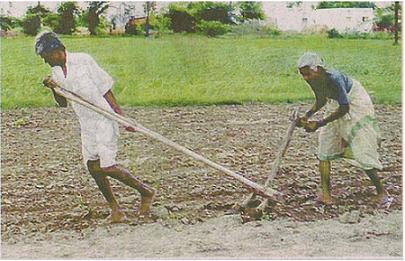
FOR WANT OF A PAIR OF BULLOCKS: Bheemrao Manigempure, a small farmer of Kadlabad village in Bidar district, Karnataka, with his son Shivasharanappa and daughter-in-law Saraswati. While the two men pull the plough, she helps them, sowing, de-weeding, or adding fertiliser and pesticides.
The family has a huge loan to repay. Bheemrao owns a small tract of land, which is anything but fertile. '`Any one else would have hanged himself by now,'' is how he explains his life. Reforms mean nothing to them.
The State Agriculture Minister and district in-charge says his ``Government understands that Bidar is one of the poorest districts in the country. We are trying to help the families that need immediate assistance.'' The question is when will this help come. Bidar district is part of the semi-arid and drought-prone belt of northern Karnataka and has been susceptible to periodic droughts. (Courtecy : The Hindubusinessline)

Sunday, October 08, 2006